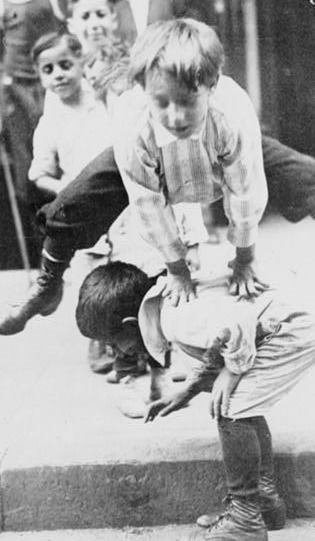
Photo from "Games in the Street", by Rachel Gallagher, 1976
How warped is a society when laws must be passed to ban children from playing in the street? Think about it. Streets make up a large percentage of the total land surface in the city, and they are owned by the public. Should cars have total monopoly on this public resource? As a child I played many summer days in our small residential street. It is the meeting place of all the kids of all ages, and it is within watch of the surrounding houses.
We should be clear about this. This proposed law has nothing to do with the safety of the kids. The playing going on is on small residential side streets. There are already laws against stopping traffic, and no one has claimed that kids are playing in high-traffic areas. The problem is a bunch of whiny old people who can't remember what it was like to play kick the can or pick-up ball. If there is a problem on a specific street, then talk to the kids, or if they are punks, talk to the police, and they use their judgement and will move them on if needed. There is absolutely no need to outlaw all playing in the street. Why not outlaw play on sidewalks, near streets, or all play in public view? Or outlaw kids totally, as they are always yelling, running and generally disturbing the peace with their balls, bats and bikes. I suspect that this law is actually about race and basketball.
Do you want to live in a city in which car speed is encouraged at the expense of play?
03 October 2007
02 October 2007
Walkers Subsidize Drivers
An interesting article claiming that cars do not pay their way (ie: walking taxpayers subsidize driving taxpayers):
I link to this for two reasons. I am tired of people complaining about the price of gas and voting against any politician (if there are any) that proposes to raise the oil tax. Secondly, I am tired of hearing people say that rail/bus service must pay for itself. It is hard for other transportation methods to compete with subsidized cars.
The only thing I would add is that subsidy of any transport, will increase the distance that people travel daily. Lacking subsidy, more people would live closer to work and shops.
The analysis indicates that in the U.S. current tax and fee payments to the government by motor-vehicle users fall short of government expenditures related to motor-vehicle use by approximately 20-70 cents per gallon of all motor fuel. (Note that in this accounting we include only government expenditures; we do not include any "external" costs of motor-vehicle use.)
That implied subsidy of 20 to 70 cents a gallon -- which excludes social and environmental costs such as climate damage and uncompensated crash costs, which Delucchi has tallied elsewhere -- equates to 7 to 25 percent of the current price of gasoline. On a dollar basis, U.S. drivers are underpaying local, state and national governments by $40 to $105 billion a year.
I link to this for two reasons. I am tired of people complaining about the price of gas and voting against any politician (if there are any) that proposes to raise the oil tax. Secondly, I am tired of hearing people say that rail/bus service must pay for itself. It is hard for other transportation methods to compete with subsidized cars.
The only thing I would add is that subsidy of any transport, will increase the distance that people travel daily. Lacking subsidy, more people would live closer to work and shops.
Hocking Hills Weekend Getaway
October is the perfect month to take a weekend trip to Hocking Hills. If you take the kids, walk the trails in the hollows, the ridge trails have some very steep drops that would frighten any normal parent. State cabin rentals here.
Ash Cave:
01 October 2007
Subscribe to:
Posts (Atom)