Showing posts with label outdoors. Show all posts

26 April 2010

Non-Tech Urban Life

I'm not sure if I am up to an essay tonight, but I've had a thought that I wanted to try to express, and I'll get to it in a round about way, starting with a question.

Who spends more time outdoors: children in the city or children in the suburbs?

You would think that the answer is pretty simple, as one of the key reasons people prefer the suburbs is so that they can have a large yard in which the children can play.

But how much to the kids really use that yard? And how much time do they spend at video games or watching TV? And how much time do they spend as passengers in cars going to malls or the movies?

It just so happened, that I was watching a lecture on Youtube, and the guy referenced this statistic, which I followed up with a Google search. The result is a graph from 1990 showing where 11 year old children in California spent their time. The graph represents an average for all seasons and thus includes the school days but despite California having a temperate climate, the 10% of time spent outdoors does not surprise me at all. In fact I would suspect that today the number is even lower, maybe significantly lower.


But the graph is just a crude way to approach my subject.

Think about when you were eleven years old. What are the places in which you spent your most memorable times? For me they were all outdoors, and they are all times and places that had almost no technology involved. It would be playing outdoors, ice-skating, building forts, pickup baseball, bike riding etc... I do also have some fond memories of this time playing board games and card games inside, but for a child of this age, memories are forged mostly outdoors away from computer screen or TV screens.

While there are certainly exceptions, it seems to me that most suburban children today are raised indoors. And certainly you can do the same if you are living in the city. You can surround yourself with distractions such that you are barely aware of the changing weather outside your window.

But a family can make a conscious decision to not take this path. And an urban household could be one with few electronic devices. And, while you can live downtown, and still drive almost everywhere; if you make a decision that you don't want to live that way, then each walk to the store or to the museum is an adventure.

For example, my kids were pretty miserable walking home Saturday in a downpour. They complained as I extended the trip home to stop for a few groceries. But as usual, they forgot their misery, they loved the puddles, and the banter and the chasing. And when we finally got home they almost begged for a hot bath. And an hour later, completely exhausted they were washed and asleep in a dry bed probably dreaming of the fun they had. (or cursing me, I'm not totally sure)

There are few things that kids really crave. And after a loving, stable family the next craving is just the chance to run, climb and play. And in this century when schools are handing out homework in kindergarten, and organized sports take over most of the evenings and weekends, kids just don't have the chance to explore and play outdoors as was the norm when we were children.

But for many children (and this is certainly true of my son) they have another craving, and that is peace and quiet. I can see my son sometimes, getting frustrated with the constant assault for his attention. And when the chance comes, and he can be quiet, and draw, or walk in solitude, finally, he can clear his head and regain some inner peace. I'm not saying he will be denied use of the computer. No, but it will be limited, and I am thinking of completely ditching the TV, and keeping the radio off... and of course, walking evermore places.

18 November 2009

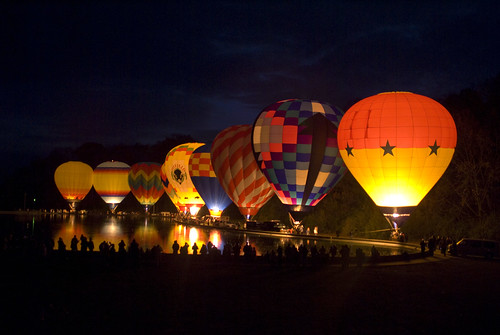
Balluminaria This Saturday


This year's Balluminaria is scheduled for this Saturday at Eden Park. The event runs from 4 to 6 pm and includes the hot air balloons and holiday music.

You can see more details at the CincinnatiUSA web site.

20 May 2009

Rowing, Rowing, Rowing on the River


Congratulations to the Cincinnati Junior Rowing Team which took home the Midwest Junior Rowing Championship this past weekend. They won 8 gold medals as well as the Team Points Trophy with a total of 215 points. The second team earned 106.5 points. The Cincinnati team advances to the Nationals which will be held in June.

Congratulations to Steven Boyle, Lance Brown, Sam Elsbrock, Eric Garbon, Tom Garry, Matthew Habel, Clay Kadon, Brad Kallmeyer, Adam Miller, Grant Olscamp, Arthur Olson, Ian Powers, Damien Retzinger, Michael Robison, Nick Shaffer, Jacob Smith, Alex Spaulding, Tom Spraul, Eric Swank, Clay Wagner, Dan Weber.

Every day after school and most Saturdays you can find them on the Licking River. During the winter they train in the tank under Montgomery Inn Boathouse. They compete throughout the eastern USA and Canada.

22 August 2007

The Best Kite

 
Posted by Picasa
This kite sits in our glove compartment, and is super easy to fly. No messy assembly like the paper and wood kites I got from the local hobby shop as a kid. Ours cost about $15 at Joseph Beth, but they are available on the web etc. We have gotten lots of use out of it, and it shows no sign of wear. Comes with spool, string, and collapsible parafoil kite; all rolled up in a 3"x6" bag.

20 August 2007

Stargazing in the city

Our family saw dramatic shooting stars last week while out of town. At the time, I didn't realize that it was the middle of the Perseid Meteor shower.

We also gazed at the Milky Way, a sight which most suburban and urban children now rarely see.

We also saw satellites travelling across the sky, which I never see from my city perch.

Our city balcony faces west, which means we can often observe planets following the sunset, and can see more stars than you would think, being that we live amongst much light pollution. It is important for me and my children to be able to sit out at night and stargaze. We are not astronomers; not even amateurs, but we enjoy it nonetheless.

Make no doubt about it, excess light is pollution. Light shining up into the sky is in essence, wasted energy; caused by laziness on the part of engineers and ignorance of property owners. They install improperly designed and improperly directed light, and they insist that more is better, which is not true. Just enough light is best.

Sure, light pollution is pretty low on most people's priorities (below things such as crime, transportation, schools and dozens of other things) but I think it is another quality of life issue, up there with other local forms of pollution such as litter, noise and graffiti, that make city living less pleasant. Some cities, such as Tuscon, near Kitt Peak Observatory, have implemented light trespass ordinances to much success.

A study of Cincinnati would probably show that road lighting as well as uplighting on buildings cause the most damage. What would it take to start installing "full cut-off" fixtures at these locations? Most street lighting would provide the same function, and would have less distracting glare to drivers, if it was shielded so that the light shines downward, not horizontally or upward. Building lighting can be done with neon outline lights or downlights, or portions, such as the top of a tall builings can be internally illuminated to great effect.

Although our night sky is ruined by light from dozens of jurisdictions, it would be a great start and a great statement for the City of Cincinnati to pass a light pollution ordinance.

24 July 2007

A Good Playground


Ault park
The playground here has two swing sets, and two play structures, all located under the shade of large cypress trees. There is a winding path, seating for parents, drinking fountains, toilets, and picnic tables; all in good working order. Hard to find a Cincinnati Recreation playground half as good anywhere on the west side.

[where: 3600 Observatory Avenue, Cincinnati, OH 45208]

19 June 2007

Children "roam" space shrinking


Article in a UK newspaper

"I was able to go out quite freely - I'd ride my bike around the estate, play with friends in the park and walk to the swimming pool and to school," said Mrs Grant, 36.

"There was a lot less traffic then - and families had only one car. People didn't make all these short journeys."

Today, her son Edward spends little time on his own outside his garden in their quiet suburban street. She takes him by car to school to ensure she gets to her part-time job as a medical librarian on time.

While he enjoys piano lessons, cubs, skiing lessons, regular holidays and the trampoline, slide and climbing frame in the garden, his mother is concerned he may be missing out.

She said: "He can go out in the crescent but he doesn't tend to go out because the other children don't. We put a bike in the car and go off to the country where we can all cycle together.

"It's not just about time. Traffic is an important consideration, as is the fear of abduction, but I'm not sure whether that's real or perceived."

She added: "Over four generations our family is poles apart in terms of affluence. But I'm not sure our lives are any richer."

11 June 2007

Raising Children in Captivity

A BBC article laments that parents don't let their children out to play with freinds:

Adrian Voce, from the Play England project, said it was unfair to blame parents as they only had their children's well-being at heart.

"Compared to the well-being derived from being out and about and socialising and growing and developing, weighed up against real threats to your child's safety - real or perceived threats - it's a no-brainer for parents," he said.

"They'd rather their child was short of a few friends and over-weight than dead on the road."

We are rearing our children in captivity - their habitat shrinking almost daily.

In 1970 the average nine-year-old girl would have been free to wander 840 metres from her front door. By 1997 it was 280 metres.

Now the limit appears to have come down to the front doorstep.

"You might get kidnapped or taken by a stranger," says Jojo.

"In the park you might get raped," agrees Holly.

Don't they yearn to go off to the woods, to climb trees and get muddy?

No, they tell me. The woods are scary. Climbing trees is dangerous. Muddy clothes get you in trouble.

25 May 2007

Leave no Child Inside

Richard Louv returns June 19. Register here.

11 May 2007

Let Kids Outdoors!

Fear keeps too many children inside all the time:


At a PTA meeting, during a discussion of traffic problems around the school campus, I asked what we could do to encourage families to walk or bike to school. Other parents looked at me as if I'd suggested we stuff the children into barrels and roll them into the nearest active volcano. One teacher looked at me in shock. "I wouldn't let my children walk to school alone … would you?"

"Haven't you heard about all of the predators in this area?" asked a father.

"No, I haven't," I said. "I think this is a pretty safe neighborhood."

"You'd be surprised," he replied, lowering his eyebrows. "You should read the Megan's Law website." He continued: "You know how to solve the traffic problem around this school? Get rid of all the predators. Then you won't have any more traffic."
...
Our hyper-anxiety about the safety of children is creating a society in which any outdoor activity that doesn't take place under the supervision of a coach or a "psychomotor activities" mandate from the state is too risky to attempt.
...
A child is almost as likely to be struck by lightning as kidnapped by a stranger, but it's not fear of lightning strikes that parents cite as the reason for keeping children indoors watching television instead of out on the sidewalk skipping rope.

And when a child is parked on the living room floor, he or she may be safe, but is safety the sole objective of parenting?
...
Which scenario should provoke more panic: the possibility that your child may become one of the approximately 100 children who are kidnapped by strangers each year, or one of the country's 58 million overweight adults?


L.J. Williamson, LA Times

03 May 2007

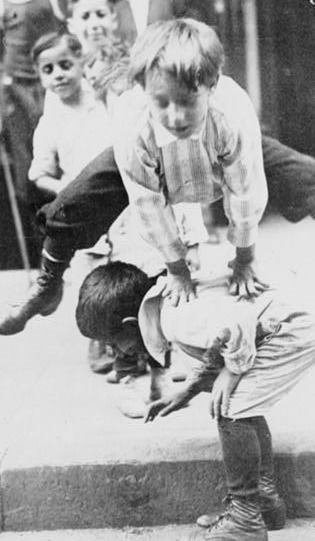
Games in the Street


What good is playground equipment for children over 5 years old? The padded, plastic and rubberized stuff that Cincinnati Recreation Commission installs is only fun (read: challenging) for children ages 2-5. Then they post a sign that says "this playground intended for children ages 5-12".

What use does a 12 year old have for a three-foot long slide? They would rather be playing on the street like the photo above.

Photo from book "Games in the Street", by Rachel Gallagher, 1976 Brooklyn

30 April 2007

Shooting Craps


Fascinating photo from Cincinnati, 1908
Photo by Lewis Hines, who was documenting the poor living and working conditions of children.
I found the photo at this site.

27 April 2007

Eat Dirt

“In most highly developed countries,” she says, “children are not allowed to roam and range the way they did when I was younger. Every species requires this range behaviour, where you go further and further from the supervision of the parent. That doesn’t happen much any more. Kids are programmed from the time they wake up in the morning to the time they go to bed. They’re in classes or after-school programmes; there aren’t the vacant lots where they can go and build a fort or have their own space. These no longer exist in most urban areas or people feel it’s too unsafe for their children to be somewhere unsupervised. This has changed the quality of childhood.”

The new mollycoddling can damage children’s health, she says. “Obesity, asthma and attention deficit disorder are all environmentally related. Kids are not moving and exploring, using their bodies the way they’re meant to be used – out in the world. This might sound silly but we’re eating less dirt than before. When you don’t eat dirt, your immune system doesn’t make the kind of antibodies to protect yourself from the diseases we’re seeing. So the sanitisation of the world is hurting children in insidious ways. Getting dirty, being part of nature develops healthy human beings. That’s why the garden’s important.”