Showing posts with label pedestrians. Show all posts

30 August 2010

Intersection Density


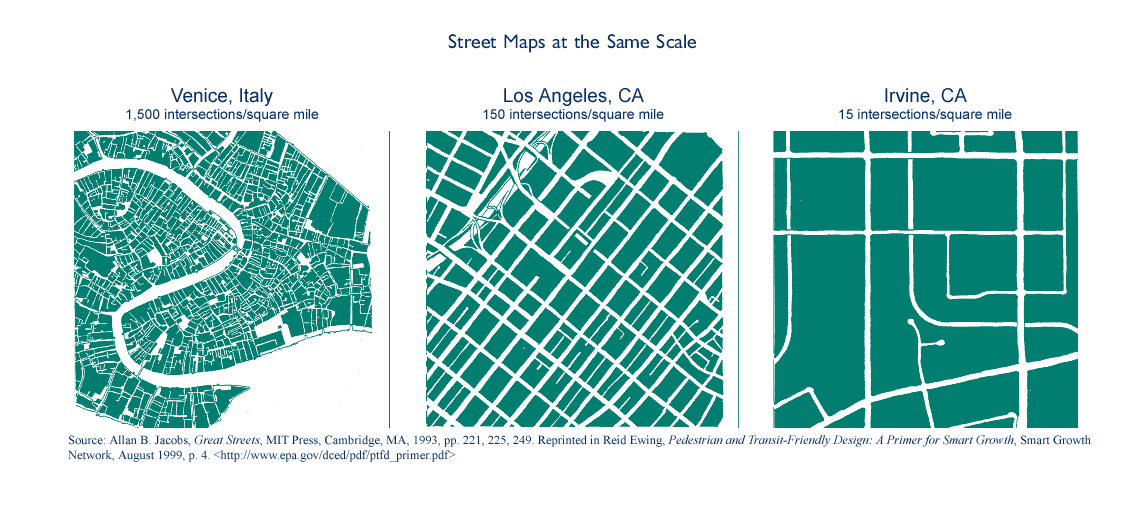
The Power of Intersection Density

Intersection density is the number of intersections in an area. It corresponds closely to block size — the greater the intersection density, the smaller the blocks. Small blocks make a neighborhood walkable.

...Of all the built environment measurements, intersection density has the largest effect on walking — more than population density, distance to a store, distance to a transit stop, or jobs within one mile. Intersection density also has large effects on transit use and the amount of driving...

Continued here

21 August 2010

Ravine at McMillian

Excellent!! Contractor is currently widening the sidewalk at the very top of Ravine:
 

16 May 2008

How to Cross a Busy Street

Some streets are inherently safer for pedestrians. However if you can't redesign the street, there is the holographic image to help you.


And if that is too expensive, you can always try these Crosswalk Flags:
 

11 March 2008

Busy City Street 107 Years Ago

Thomas Edison Film: What Happened on 23rd Street, NYC, August 21, 1901. I thought the way pedestrians owned the street was interesting. There are horses with carts and streetcars, mixing with jay-walking pedestrians.

02 October 2007

Walkers Subsidize Drivers

An interesting article claiming that cars do not pay their way (ie: walking taxpayers subsidize driving taxpayers):

The analysis indicates that in the U.S. current tax and fee payments to the government by motor-vehicle users fall short of government expenditures related to motor-vehicle use by approximately 20-70 cents per gallon of all motor fuel. (Note that in this accounting we include only government expenditures; we do not include any "external" costs of motor-vehicle use.)

That implied subsidy of 20 to 70 cents a gallon -- which excludes social and environmental costs such as climate damage and uncompensated crash costs, which Delucchi has tallied elsewhere -- equates to 7 to 25 percent of the current price of gasoline. On a dollar basis, U.S. drivers are underpaying local, state and national governments by $40 to $105 billion a year.

I link to this for two reasons. I am tired of people complaining about the price of gas and voting against any politician (if there are any) that proposes to raise the oil tax. Secondly, I am tired of hearing people say that rail/bus service must pay for itself. It is hard for other transportation methods to compete with subsidized cars.

The only thing I would add is that subsidy of any transport, will increase the distance that people travel daily. Lacking subsidy, more people would live closer to work and shops.
27 April 2007

Trim Urbanites

Another article about how healthy it is to live in an urban environment in which you must walk a lot. This kind of article is appearing more and more often.

Of course, when many families choose a suburban life, they make a clear-eyed choice: to sacrifice the adults' health and well-being (with a longer commute, fewer cultural attractions, etc.) for the children's well-being.

The suburbs are presumably built with children in mind -- with crime-free residential neighborhoods, backyards and cul-de-sacs to play in and better schools. But studies have shown that the new suburban realities may be affecting children's health as well.

An estimated 20 percent of school-age children are obese. And only 13 percent of children walk to school, compared with 66 percent in 1973. Sometimes even those playful, active creatures for whom the suburbs were made find themselves stranded like commuters on a long ride to an unhealthy adulthood.