Showing posts with label PC-BS. Show all posts

05 November 2009

Googies or Gypsies are Coming

For some reason, we have two copies of "Where the Sidewalk Ends" at our house. I think one was my wife's and one was mine. But anyway, I just noticed last night that in the newer one, the word Gypsy was changed to Googie. I don't know much about Shel Silverstein, but I am assuming that when he wrote the original in approximately 1974, that he was unaware of the Gypsie/Roma history of discrimination. I am pretty sure that the Googie change came before Silverstien died in 1999.

Gypsy first verse:


Googies first verse:


Googie Image. Maybe it was a good idea to change from Gypsy. The image is quite "Gypsy" looking:


The books are exactly the same, except the price on the earlier one was $9.95 and was published by Harper and Row, and the newer one is priced at $14.95 and published by Harper Collins. My earlier book is inscribed and dated Christmas 1980, but the later one has no obvious date.

20 October 2008

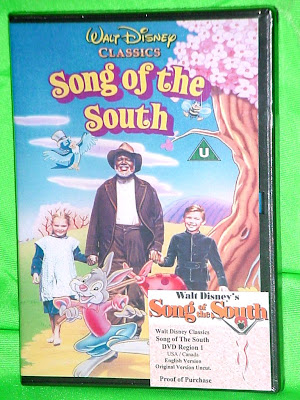
Song of the South


Disney first released this picture in 1946, and there was some racial controversy about it even then. The NAACP acknowledged "the remarkable artistic merit" of the film, but decried the supposed "impression it gives of an idyllic master-slave relationship" (even though the film was set after the American Civil War). It was shown on television in 1972 and in theatres in 1986. Other than that, Disney has never released it on home video in the USA because executives believe it might be construed as racially insensitive. It had previously been released on home video in England and Japan, but was withdrawn worldwide in 2001. Bootleg copies are widely circulated, and to their credit, the Disney Corporation has not brought legal action.

Based on the Uncle Remus cycle of stories by Joel Chandler Harris, it was Walt Disney's first live-action film, though it also contains major segments of animation. The live actors provide a sentimental framework, in which Uncle Remus relates the folk tales of the adventures of Br'er Rabbit and his friends. Maurice Rapf was asked by the Walt Disney Company to turn the stories into a shootable screenplay. One of the reasons Disney hired Rapf to was to temper what Disney feared would be a white Southern slant. Rapf was a minority, a Jew, and an outspoken left-winger, and he feared that the film would inevitably be Uncle Tomish. "That's exactly why I want you to work on it," Walt told him, "because I know that you don't think I should make the movie. You're against Uncle Tomism, and you're a radical." Rapf initially hesitated, but when he found out that most of the film would be live-action and that he could make extensive changes, he accepted the offer.

14 October 2008

Goodbye Moon


New editions of this 61 year old children's classic will have the cigarette photoshopped out of the illustrator's picture on the back cover. HarperCollins said it made the change to avoid the appearance of encouraging smoking.

Everyone can agree with that goal, but isn't this just a little bit too much? There's quite a difference between discouraging something and pretending it never existed in the first place.

After all, Bob 5chw4r7z has been known to enjoy a stogie on occasion, and that hasn't kept him from being a stand-up guy. And none other than Santa Claus himself puffs a pipe. The horrors!


"His cheeks were like roses, his nose like a cherry!
His droll little mouth was drawn up like a bow,
And the beard of his chin was as white as the snow;
The stump of a pipe he held tight in his teeth,
And the smoke it encircled his head like a wreath
;
He had a broad face and a little round belly,
That shook, when he laughed like a bowlful of jelly."

This is just another example of political correctness run amok. Novelist and children's book author, Karen Karbo, carried it to its logical end in her NY Times Op Ed.

Others have added their two cents:

The spiked curtain rods are dangerous and could easily skewer Bunny. That clunky old telephone at Bunny's bedside is also a danger. Really, Bunny, if left unsupervised by the quiet old lady, could be brained by the heavy receiver or strangled by the cord. Replace it with a new lightweight cordless or, better yet, a wall-mounted monitoring unit that would also enable letting go the quiet old lady. Bunny's bed has no restraining rails. Bunny could roll out of bed and be seriously hurt. These should be installed at once.


Karen Karbo's suggestions, while excellent, do not consider Bunny's mental health. A close examination of the clock above the fireplace shows that the time is 7 p.m. at the start of the book. At the end of the book, the time is 8:10 p.m., indicating that it takes Bunny 70 minutes to fall asleep. It is concerning that the book implies that this length of time is acceptable. On the contrary, 70 minutes to fall asleep suggests that Bunny is suffering from undiagnosed and untreated insomnia. Suggested change: Digitally alter the clock so that the elapsed time is 20 minutes. Alternatively, add a footnote indicating that Bunny is seeing a sleep specialist or child psychotherapist to address the insomnia.