...the ripping up of streetcar lines and their replacement with buses also ripped the urban fabric. Most people like riding streetcars, but almost no one likes riding a bus. The substitution of buses for electric streetcars drove most former streetcar riders to drive.
When people took the streetcar to town — and every American city or town with 5,000 or more people once had streetcars — they also spent a lot of time on Jane Jacobs’ all-important sidewalks. There, they performed multiple functions: eyes on the street, office worker, restaurant diner, shopper, theater-goer and more.
Once they drove into the city, their time on sidewalks dropped and with it shrank the number of roles they filled. They drove as close to their (usually single) destination as they could, parked, and walked only as far as necessary. When their business was done, their car drew them like a magnet and as soon as they could press the starter pedal they were gone. Stores, restaurants, and theaters moved to the suburbs where parking was easier. In time offices followed, and the city’s sidewalks emptied except for the occasional beggar or wino. My home city, Cleveland, lost its streetcars in 1953, and the downtown’s decline began. If Ohio had tumbleweeds, they would now blow down Euclid Avenue.
Cities such as Portland, Oregon and Kenosha, Wisconsin that have brought streetcars back have found the sidewalks come to life again. So have shops, theaters and restaurants. Streetcars are pedestrian facilitators, more so than subways. People walk, take the streetcar, then get off and walk some more.
Cities need streetcars. They are not a cure-all; if people do not feel safe on city sidewalks, nothing will move them to walk there. But if a city can restore order, streetcars are more likely to fill its sidewalks with people than anything else.
- William Lind is director of The American Conservative Center for Public Transportation.
Showing posts with label streetcar. Show all posts
Showing posts with label streetcar. Show all posts
09 October 2011
A Conservative on Streetcars

24 May 2010
Enquirer Runs Wrong Headline
The Enquirer ran a headline this morning pushing their agenda on the streetcar:
The Headline said: Enquirer Poll Buoys Streetcar Foes
But when you look at the numbers they show:
19% say they would ride every day.
Cincinnati's population is just about 1/3 of a million people; 19% is 63,000 daily riders!
In addition,
31% say they would ride several times a week. That's 103,000 riders!
56% say they would ride at least monthly, that is 186,000 riders!
Seems to me the headline should have been something along the lines of "Majority of Residents Plan to Ride Streetcar".
The Headline said: Enquirer Poll Buoys Streetcar Foes
But when you look at the numbers they show:
19% say they would ride every day.
Cincinnati's population is just about 1/3 of a million people; 19% is 63,000 daily riders!
In addition,
31% say they would ride several times a week. That's 103,000 riders!
56% say they would ride at least monthly, that is 186,000 riders!
Seems to me the headline should have been something along the lines of "Majority of Residents Plan to Ride Streetcar".
11 November 2009
Wall or Connection
For Veteran's day, and 20yrs after the fall of the wall:
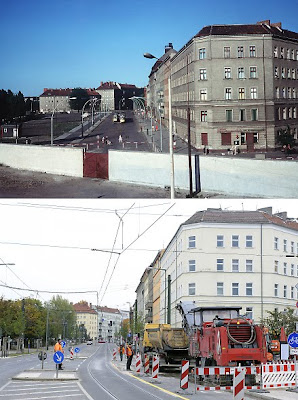
Berlin's Bernauer Strasse one with the Berlin Wall in June 1968, and the same view on October 20, 2009 without the wall and with a streetcar track and wires.
Pictures found here (JOHN MACDOUGALL/AFP/Getty Images)
Berlin's Bernauer Strasse one with the Berlin Wall in June 1968, and the same view on October 20, 2009 without the wall and with a streetcar track and wires.

Pictures found here (JOHN MACDOUGALL/AFP/Getty Images)
03 November 2009
No on Nine Endorsements
Some groups/people endorsing a "Vote no" on issue 9:
1) Former President of the Ohio State Senate Stanley Aronoff
2) Former President of the Ohio State Senate Richard Finan
3) Representative Denise Driehaus
4) Bill Cunningham - Radio Personality
5) Mike McConnell - Radio Personality
6) Cincinnatians for Progress
7) Hamilton County Regional Planning Commission
8 ) City Council Woman and former Cincinnati Mayor Roxanne Qualls
9) The League of Women Voters of the Cincinnati Area
10) St Louis Urban Workshop
11) UC Student Government
12) The Cincinnati Zoo
13) Cincinnati AFL-CIO Labor Council
14) Councilman Chris Bortz
15) Cincinnati Charter Committee
16) Hamilton County Democrats
17) Councilman Jeff Berding
18) The Cincinnati Regional Chamber of Commerce
19) The Cincinnatus Association
20) Councilman Kevin Flynn
21) Councilman Cecil Thomas
22) Mayor Mark Mallory
23) Councilman David Crowley
24) Councilman Greg Harris
25) Councilwoman Leslie Ghiz
26) Hamilton County Commissioner David Pepper
27) Hamilton County Commissioner Todd Portune
28) Former Mayor Arn Bortz
29) Former Mayor Bobbie Sterne
30) Former Vice Mayor Jim Tarbell
31) State senator Eric Kearney
32) Cincinnati Business Courier
33) Cincy PAC
34) Hispanic Chamber of Commerce
35) Mayor's YPKC
36) Over-The-Rhine Chamber of Commerce
37) US Green Building Council - Cincy Chapter
38) Downtown Resident Council
39) Queen City Bike
40) Pendleton Neighborhood Council
41) Cincinnati Planning Commission
42) Cincinnati Enquirer Editorial Board
43) Cincinnati Democratic Party
44) The Sierra Club
45) All Aboard Ohio
46) Agenda 360
47) Southwest Ohio Regional Transit Authority
48) African American Chamber of Commerce
1) Former President of the Ohio State Senate Stanley Aronoff
2) Former President of the Ohio State Senate Richard Finan
3) Representative Denise Driehaus
4) Bill Cunningham - Radio Personality
5) Mike McConnell - Radio Personality
6) Cincinnatians for Progress
7) Hamilton County Regional Planning Commission
8 ) City Council Woman and former Cincinnati Mayor Roxanne Qualls
9) The League of Women Voters of the Cincinnati Area
10) St Louis Urban Workshop
11) UC Student Government
12) The Cincinnati Zoo
13) Cincinnati AFL-CIO Labor Council
14) Councilman Chris Bortz
15) Cincinnati Charter Committee
16) Hamilton County Democrats
17) Councilman Jeff Berding
18) The Cincinnati Regional Chamber of Commerce
19) The Cincinnatus Association
20) Councilman Kevin Flynn
21) Councilman Cecil Thomas
22) Mayor Mark Mallory
23) Councilman David Crowley
24) Councilman Greg Harris
25) Councilwoman Leslie Ghiz
26) Hamilton County Commissioner David Pepper
27) Hamilton County Commissioner Todd Portune
28) Former Mayor Arn Bortz
29) Former Mayor Bobbie Sterne
30) Former Vice Mayor Jim Tarbell
31) State senator Eric Kearney
32) Cincinnati Business Courier
33) Cincy PAC
34) Hispanic Chamber of Commerce
35) Mayor's YPKC
36) Over-The-Rhine Chamber of Commerce
37) US Green Building Council - Cincy Chapter
38) Downtown Resident Council
39) Queen City Bike
40) Pendleton Neighborhood Council
41) Cincinnati Planning Commission
42) Cincinnati Enquirer Editorial Board
43) Cincinnati Democratic Party
44) The Sierra Club
45) All Aboard Ohio
46) Agenda 360
47) Southwest Ohio Regional Transit Authority
48) African American Chamber of Commerce
02 November 2009
Joe Sprengard on Smart City
I've been offline a lot lately, but I haven't seen anyone else note that last week, Joe was on a nationally syndicated show, Smart City with Carol Coletta. He is a great spokesman. If you have time, listen past the first 10 minutes. At the beginning, they review the issue, which by now is probably pretty well-known to anyone who reads the local blogs. But as the interview progresses, they cover the bigger picture of livable cities, coalition building and choosing to live here.
Tomorrow, Please Vote No on Nine.
Tomorrow, Please Vote No on Nine.
23 October 2009
Issue 9 Mythbusting, or Why Issue 9 is not only about the Streetcar
There are a lot of myths flying around about Issue 9 as we approach the election. It seems every stage of the process has been designed to confuse and deceive voters. I thought the use of "deceive" was a little harsh until I heard COAST defending their wording of the ballot issue, now I feel very comfortable with it.
Now I am not saying I have heard all these myths from COAST. Some are only implied in their rhetoric, and some I have heard from others. I am also sure you can add more in the comments, please feel free.
MYTH: Issue 9 is only about the Streetcar
FACT: Issue 9 will affect a much broader range of projects
I don't think we need to belabor this point. We have already covered COAST's use of the "Queen's English" (their term for technical legal latin abbreviations) that make the wording appear to focus on streetcars and trollies, while covering any light passenger rail. I know COAST likes to mock the issue of it affecting the train at the Zoo (even though it would). I am more concerned of the impact on passenger rail systems like the proposed high-speed rail connection in Ohio. If I really wanted to be more conspiracy minded I would pursue the fact that most of COAST's members live in the burbs, and the effect of this issue could cause the rail to stop in one of those communities rather then go into the city. All in all, if you are against the Streetcar, voting Yes on 9 is like going after a fly with a sledge hammer.
MYTH: Voting Yes on Issue 9 will stop the Streetcar
FACT: Voting Yes on Issue 9 will require another vote to stop the Streetcar
Here is the Yes on 9 sign:

It's kind of your worst work-realted nightmare. The meeting to determine when we need a meeting. The only thing a Yes vote guarantees is that we will have a vote if the city wants to build a Streetcar, or use public funds to bring high-speed rail into the city, or expand the train at the Zoo. Seems silly, doesn't it. Now to be fair, "For Cincy Jobs" seems a bit of a stretch for the No on 9 signs, but Yes on 9 will not stop the streetcar.
MYTH: Voting Yes on Issue 9 is a vote for democracy
FACT: Voting on Issue 9 is democracy already
I find it amusing that they wrap this issue in the concept that Yes is about democracy. "We Demand a Vote". Well, we have a vote. It's called representative democracy. We vote representatives into office, and they make decisions. If we don't like those decisions, we vote them out. We do this because a majority rule on every single detail of public issue is truly counter-productive. It is not because people are too dumb to vote on it, it is because people don't have enough time to fully educate themselves on every project. Rail is going to require a big-picture perspective on things. It is going to require that the decision makers balance a number of issues. It does not work well in a sound-bite popular vote. We can already see how folks are trying to deceive voters.
MYTH: Voting Yes will slow down those hasty politicians
FACT: Seriously? The problem in Cincinnati is we move too FAST on things?
It will slow down the process by creating extra hurdles, but is Cincinnati's problem that we move too fast, or we move too slow? We all know the apocryphal Twain quote. And wow, Fountain Square west moved SO fast. And that Bank's project... if we could have only slowed that down.
MYTH: Vote Yes because the government shouldn't be making these decisions without a vote
FACT: Why are we starting this now? The government already makes these decisions
You remember when we all voted for the Fort Washington Way project? And on the proposed expansion of 75? When are we voting on the Brent-Spence Bridge? Oh wait, we don't. The government heavily subsidizes the road system. I'm glad they do, but the gas tax isn't paying for all of the cost associated with the system. Frankly I could care less about the 75 expansion, I don't need to ride that section of 75. So why don't we vote on that? Because we need folks to look at the big picture, and make planning decisions that benefit the whole region, not just me.
MYTH: If you are against the Streetcar you should vote Yes on 9
FACT: A LOT of anti-streetcar folks are voting No on 9
Have we mentioned the scope is beyond streetcars. Even Bill Cunningham expressed dismay over the wording of Issue 9. Listen to the audio. He thought it was a bad issue (though he said he won't be voting on it since he lives out of the city). And he cannot stand the streetcar. There are a lot of council members and candidates who are against the streetcar, who are very much against Issue 9.
What kills me, is the GoCoast Twitter account twittered this:

More Half-truths. Willy DID say we should stop the ridiculous trolley, but he also said Issue 9 was bad. This is yet another purposefully misleading statement from COAST.
So, in my opinion, whether you are for the streetcar or not, you should vote No on 9. It is a bad piece of law we don't want in our City's charter.

Now I am not saying I have heard all these myths from COAST. Some are only implied in their rhetoric, and some I have heard from others. I am also sure you can add more in the comments, please feel free.
MYTH: Issue 9 is only about the Streetcar
FACT: Issue 9 will affect a much broader range of projects
I don't think we need to belabor this point. We have already covered COAST's use of the "Queen's English" (their term for technical legal latin abbreviations) that make the wording appear to focus on streetcars and trollies, while covering any light passenger rail. I know COAST likes to mock the issue of it affecting the train at the Zoo (even though it would). I am more concerned of the impact on passenger rail systems like the proposed high-speed rail connection in Ohio. If I really wanted to be more conspiracy minded I would pursue the fact that most of COAST's members live in the burbs, and the effect of this issue could cause the rail to stop in one of those communities rather then go into the city. All in all, if you are against the Streetcar, voting Yes on 9 is like going after a fly with a sledge hammer.
MYTH: Voting Yes on Issue 9 will stop the Streetcar
FACT: Voting Yes on Issue 9 will require another vote to stop the Streetcar
Here is the Yes on 9 sign:

It's kind of your worst work-realted nightmare. The meeting to determine when we need a meeting. The only thing a Yes vote guarantees is that we will have a vote if the city wants to build a Streetcar, or use public funds to bring high-speed rail into the city, or expand the train at the Zoo. Seems silly, doesn't it. Now to be fair, "For Cincy Jobs" seems a bit of a stretch for the No on 9 signs, but Yes on 9 will not stop the streetcar.
MYTH: Voting Yes on Issue 9 is a vote for democracy
FACT: Voting on Issue 9 is democracy already
I find it amusing that they wrap this issue in the concept that Yes is about democracy. "We Demand a Vote". Well, we have a vote. It's called representative democracy. We vote representatives into office, and they make decisions. If we don't like those decisions, we vote them out. We do this because a majority rule on every single detail of public issue is truly counter-productive. It is not because people are too dumb to vote on it, it is because people don't have enough time to fully educate themselves on every project. Rail is going to require a big-picture perspective on things. It is going to require that the decision makers balance a number of issues. It does not work well in a sound-bite popular vote. We can already see how folks are trying to deceive voters.
MYTH: Voting Yes will slow down those hasty politicians
FACT: Seriously? The problem in Cincinnati is we move too FAST on things?
It will slow down the process by creating extra hurdles, but is Cincinnati's problem that we move too fast, or we move too slow? We all know the apocryphal Twain quote. And wow, Fountain Square west moved SO fast. And that Bank's project... if we could have only slowed that down.
MYTH: Vote Yes because the government shouldn't be making these decisions without a vote
FACT: Why are we starting this now? The government already makes these decisions
You remember when we all voted for the Fort Washington Way project? And on the proposed expansion of 75? When are we voting on the Brent-Spence Bridge? Oh wait, we don't. The government heavily subsidizes the road system. I'm glad they do, but the gas tax isn't paying for all of the cost associated with the system. Frankly I could care less about the 75 expansion, I don't need to ride that section of 75. So why don't we vote on that? Because we need folks to look at the big picture, and make planning decisions that benefit the whole region, not just me.
MYTH: If you are against the Streetcar you should vote Yes on 9
FACT: A LOT of anti-streetcar folks are voting No on 9
Have we mentioned the scope is beyond streetcars. Even Bill Cunningham expressed dismay over the wording of Issue 9. Listen to the audio. He thought it was a bad issue (though he said he won't be voting on it since he lives out of the city). And he cannot stand the streetcar. There are a lot of council members and candidates who are against the streetcar, who are very much against Issue 9.
What kills me, is the GoCoast Twitter account twittered this:

More Half-truths. Willy DID say we should stop the ridiculous trolley, but he also said Issue 9 was bad. This is yet another purposefully misleading statement from COAST.
So, in my opinion, whether you are for the streetcar or not, you should vote No on 9. It is a bad piece of law we don't want in our City's charter.

20 October 2009
Two Weeks to Election Day
There are several important issues on the ballot November 3rd, and I have read most of the ballot language and have decided how I am voting on every issue. But none of them is as important as issue 9. Not because I believe the streetcar is the answer to everything. Not because I believe passenger rail to Columbus and Cleveland will solve that many transit problems. Not even because I love the Zoo Train. The reason is because if issue Nine passes, rail transit is demoted below all other types of transit, especially those that use asphalt and gasoline.
But roads, especially construction of new roads, already have priority over any other type of construction. I was talking with a manager of a Cincinnati Suburb recently, and he was lamenting the fact that newer areas like Mason are getting all kinds of Federal and State money to build new infrastructure, but his community cannot get any funding to repair existing sewers, roads and storm systems. The system is already built in favor of sprawl and new asphalt. Why should Cincinnati write such lopsided priorities into our City Charter?
Cincinnati has been on its knees for a long time. Crawling forward while other cities are up and running. I sense that things are on the cusp of really changing, perhaps changing in a fundamental way.
Please, vote against the status quo, Vote No on Nine.

But roads, especially construction of new roads, already have priority over any other type of construction. I was talking with a manager of a Cincinnati Suburb recently, and he was lamenting the fact that newer areas like Mason are getting all kinds of Federal and State money to build new infrastructure, but his community cannot get any funding to repair existing sewers, roads and storm systems. The system is already built in favor of sprawl and new asphalt. Why should Cincinnati write such lopsided priorities into our City Charter?
Cincinnati has been on its knees for a long time. Crawling forward while other cities are up and running. I sense that things are on the cusp of really changing, perhaps changing in a fundamental way.
Please, vote against the status quo, Vote No on Nine.
14 October 2009
Coalition to Protect the City Charter
A new group The Coalition to Protect the City Charter is a Coalition of the Charter Committee, Chamber of Commerce, Cincinnatus, and the League of Women Voters.
! ! ! VOTE NO ON NINE ! ! !
...The City Charter should provide for the flexible operation of government and should not restrict City Council‘s legislative authority on specific issues. The proposed amendment is too specific for a Charter.
The Coalition further believes that using a Charter amendment to require a vote on or to prevent funding of any specific project is simply bad governance. We elect our council members to make these decisions.
! ! ! VOTE NO ON NINE ! ! !


09 October 2009
Rail Builds Better Cities
A few days ago, I saw that Liberty Township was touting the construction that is following the millions of dollars spent on a new highway interchange. This is what they are proud of:
Candlewood Suites

This is the kind of development that follows new highway interchanges. This is what is already built all across this country at every highway interchange.
Just like a highway interchange attracts development, so to does a rail stop. But since rail is people centered, not auto-centered, the development that follows is inherently better. Even if it is some ugly modern building, it is still built for pedestrians and connects with the sidewalk and city life.
Below are two photos I took last year in Portland along the streetcar line.
Under construction adjacent to streetcar:

Recently completed:

Do we want our transportation dollars supporting urban development or more auto traffic as seen below in Liberty Township?

The type of city we get flows from the type of transportation we build.
Candlewood Suites

This is the kind of development that follows new highway interchanges. This is what is already built all across this country at every highway interchange.
Just like a highway interchange attracts development, so to does a rail stop. But since rail is people centered, not auto-centered, the development that follows is inherently better. Even if it is some ugly modern building, it is still built for pedestrians and connects with the sidewalk and city life.
Below are two photos I took last year in Portland along the streetcar line.
Under construction adjacent to streetcar:

Recently completed:

Do we want our transportation dollars supporting urban development or more auto traffic as seen below in Liberty Township?

The type of city we get flows from the type of transportation we build.
08 September 2009
Crowd Connection
Findlay Market was rocking this past Saturday. It was super crowded, and more kids than usual.
I took a few random pictures:
Bumpy Bar:
.JPG)
Mild Tampa Cubs:
.JPG)
Little Dog and Ball Furniture:
.JPG)
Cigar, Beer and Stroller:
.JPG)
I noticed that lots of people were stopping and studying this proposed transit map. Its inspirational.
Looking at Map 1:
.JPG)
Looking at Map 2:
.JPG)
Looking at Map 3:

Later that afternoon, we were at Fountain Square, and it was absolutely packed for the Guiness Oyster Fest:

However, the dozen or so blocks from about 6th Street to Elder Street (at Findlay Market) were pretty desolate. As you probably already know, some are really desolate. Seems like we have these successful nodes of activity in a few spots downtown and the riverfront, but they are too far apart to generate energy off each other.
Hmmm, If only there was some way to connect these nodes and build some synergy. Seems to me some other cities might have figured out how to do this. Maybe some kind of pedestrian, ( and biker, wheelchair) assistance device that you could roll onto with your stroller, and that would be easy to understand and use. Something comfortable, quiet and maybe electric. Something that supports the nodes of activities, supports the walker, encourages storefront retail and helps enliven the sidewalks in ways that cars and buses don't. We have some good basics here, we just need the connectivity, the walkers, the transit to bring it together.
I took a few random pictures:
Bumpy Bar:
.JPG)
Mild Tampa Cubs:
.JPG)
Little Dog and Ball Furniture:
.JPG)
Cigar, Beer and Stroller:
.JPG)
I noticed that lots of people were stopping and studying this proposed transit map. Its inspirational.
Looking at Map 1:
.JPG)
Looking at Map 2:
.JPG)
Looking at Map 3:

Later that afternoon, we were at Fountain Square, and it was absolutely packed for the Guiness Oyster Fest:

However, the dozen or so blocks from about 6th Street to Elder Street (at Findlay Market) were pretty desolate. As you probably already know, some are really desolate. Seems like we have these successful nodes of activity in a few spots downtown and the riverfront, but they are too far apart to generate energy off each other.
Hmmm, If only there was some way to connect these nodes and build some synergy. Seems to me some other cities might have figured out how to do this. Maybe some kind of pedestrian, ( and biker, wheelchair) assistance device that you could roll onto with your stroller, and that would be easy to understand and use. Something comfortable, quiet and maybe electric. Something that supports the nodes of activities, supports the walker, encourages storefront retail and helps enliven the sidewalks in ways that cars and buses don't. We have some good basics here, we just need the connectivity, the walkers, the transit to bring it together.
03 September 2009
Exempli Gratia: Lawyers vs. Communicators
The recent controversy over the language of the ballot initiative handcuffing rail efforts in Cincinnati highlights, in my opinion, the difference between the goals of a lawyer, and the goals of a communicator. A lawyer serves his client. He is precise where precision is needed and imprecise where it benefits his cause.
The controversy centers around the following highlighted phrase in the ballot language (emphasis mine):
Opponents of the amendment have argued that the phrase is misleading. One issue is that by specifically calling out trolley or streetcar they are leading folks to believe that is the sole thing impacted, though “passenger rail transportation” has a far broader meaning.
COAST maintains that the use of “e.g” clearly indicates that they are two examples of a larger population. But this leads to the second issue. While “e.g” may be commonly used and understood in contracts, non-lawyers constantly confuse it. So, one would expect that the average citizen could misunderstand the phrase on the ballot.
Despite the protestations of COAST, I have been a technical communicator for 20 years. and long ago learned that people (very smart people) are confused by “e.g.” and “i.e.”. The abbreviation “e.g.” means “for example” while “i.e.” means “that is”. So again, you would expect a lot of readers of this ballot issue to read “e.g., a trolley or streetcar” as meaning only trolley or streetcar projects are impacted by this amendment. This is further exacerbated by COAST’s constant reference to the amendment as being anti-streetcar.
You can read a longer treatment of the recent meeting at Building Cincinnati.
I was especially amused by the following quote from that post:
The controversy centers around the following highlighted phrase in the ballot language (emphasis mine):
The City, and its various Boards and Commissions, may not spend any monies for right-of-way acquisition or construction of improvements for passenger rail transportation (e.g., a trolley or streetcar) within the city limits without first submitting the question of approval of such expenditure to a vote of the electorate of the City and receiving a majority affirmative vote for the same."
Opponents of the amendment have argued that the phrase is misleading. One issue is that by specifically calling out trolley or streetcar they are leading folks to believe that is the sole thing impacted, though “passenger rail transportation” has a far broader meaning.
COAST maintains that the use of “e.g” clearly indicates that they are two examples of a larger population. But this leads to the second issue. While “e.g” may be commonly used and understood in contracts, non-lawyers constantly confuse it. So, one would expect that the average citizen could misunderstand the phrase on the ballot.
Despite the protestations of COAST, I have been a technical communicator for 20 years. and long ago learned that people (very smart people) are confused by “e.g.” and “i.e.”. The abbreviation “e.g.” means “for example” while “i.e.” means “that is”. So again, you would expect a lot of readers of this ballot issue to read “e.g., a trolley or streetcar” as meaning only trolley or streetcar projects are impacted by this amendment. This is further exacerbated by COAST’s constant reference to the amendment as being anti-streetcar.
You can read a longer treatment of the recent meeting at Building Cincinnati.
I was especially amused by the following quote from that post:
"The language is an extremely simple sentence," Finney said. "It speaks for itself. These people feigning that they can't somehow understand the Queen's English, it seems to me to be a bit contrived."It seems a little out of touch to me. 1. it is an abbreviation of a Latin phrase, and 2. last I checked Cincinnati was not part of the English realm.
25 August 2009
Sustainability and the Streetcar
Many times in the streetcar debate, I hear the comment that separated-grade light rail would be a better option for Cincinnati. "We need to connect downtown to Kenwood and the Airport, not the Riverfront to Clifton", for example. I disagree. My feeling is that in a city like Cincinnati, where freeway traffic is not really a choke point in development, it is more important to build up the close-in neighborhoods before trying to connect to the suburbs.
So I ran across a study done last year for the city of Vancouver, by the University of British Columbia School of Architecture, in which they analyzed the different transportation modes. Here is the summary in PDF format. They judge these transit options based on 3 sustainability principles:
1. Shorter trips are inherently better than longer trips.
2. Low carbon is better than high carbon.
3. Which is most affordable long term?
Note that in this study, they use the word "tram" to describe a modern streetcar.
In the first sustainability principle, streetcars and electric buses score similarly:

Determining the carbon footprint takes more levels of deduction. First, how much energy is used per passenger mile:

Then they analyse the carbon emissions based on various sources of electricity. After that they extrapolate to this graph showing emissions when electricity is generated from coal. (They also have graphs using hydro power, but that is not very relevant to Cincinnati):

Then they get into capacity of the vehicles, the capital costs, and the operational costs. After combining all that info, they conclude with these graphs showing Total Cost per passenger Mile:

and current and future energy costs:

The study summarizes as follows:
"...Based on the three sustainability criteria, reducing trip length, greenhouse gas reduction, and lifecycle costs, trams represent the best investment. This investment is entirely dependent, however, on a long term commitment to balancing jobs and housing and a gradual reduction in the per capita demand for daily transportation of any kind. If most trips in the region are short then the rationale for investment in trams is overwhelming. If all trips are long then the rationale for the very expensive Skytrain system may still hold sway. Currently our region is at a tipping point between the two. Decisions made now about which mode to invest in could precipitate very different land use consequences, consequences lasting for decades. These arguments apply to every North American metropolitan area..."
So I ran across a study done last year for the city of Vancouver, by the University of British Columbia School of Architecture, in which they analyzed the different transportation modes. Here is the summary in PDF format. They judge these transit options based on 3 sustainability principles:
1. Shorter trips are inherently better than longer trips.
2. Low carbon is better than high carbon.
3. Which is most affordable long term?
Note that in this study, they use the word "tram" to describe a modern streetcar.
In the first sustainability principle, streetcars and electric buses score similarly:

Determining the carbon footprint takes more levels of deduction. First, how much energy is used per passenger mile:

Then they analyse the carbon emissions based on various sources of electricity. After that they extrapolate to this graph showing emissions when electricity is generated from coal. (They also have graphs using hydro power, but that is not very relevant to Cincinnati):

Then they get into capacity of the vehicles, the capital costs, and the operational costs. After combining all that info, they conclude with these graphs showing Total Cost per passenger Mile:

and current and future energy costs:

The study summarizes as follows:
"...Based on the three sustainability criteria, reducing trip length, greenhouse gas reduction, and lifecycle costs, trams represent the best investment. This investment is entirely dependent, however, on a long term commitment to balancing jobs and housing and a gradual reduction in the per capita demand for daily transportation of any kind. If most trips in the region are short then the rationale for investment in trams is overwhelming. If all trips are long then the rationale for the very expensive Skytrain system may still hold sway. Currently our region is at a tipping point between the two. Decisions made now about which mode to invest in could precipitate very different land use consequences, consequences lasting for decades. These arguments apply to every North American metropolitan area..."
24 August 2009
Another Streetcar Article
Ran across an article in the Portland Observer which was ostensibly about how the streetcar extensions could lead to displacement because of increasing property values. The following were interesting quotes from that article:
...The economic development created over 3,000 residential units, 800 of which are considered affordable for people of average or modest incomes.
..."It's been fabulous for urban commercial development," she said of the streetcar. "It's been a very positive impact on the community and the city."
...streetcars create "nodes of activity" that will benefit small businesses in the long term.
John Miller, the executive director of HOST, an affordable housing non-profit, hopes that future streetcars will actually help people of more modest incomes because they won't have to rely on their cars as much....
14 August 2009
Findlay Market Needs Streetcar
....parking is the big short-term issue facing the market. He said weekend crowds consistently fill the 723 spaces on surrounding streets and 155 spots in a city-owned lot north of the market....building a streetcar system that runs past the market would help...
...
Then, there’s the matter of more than 40 vacant buildings in the blocks surrounding Findlay Market. The buildings are owned by the city and the corporation, which has development rights but no money to spearhead a project. Three attempts to recruit developers have produced no results.
“We need a local residential population to secure the market’s future,” Pickford said. “If you look at it’s history, the market survived because it was surrounded by a densely populated neighborhood until 20 to 25 years ago.”
-Today's Cincinntati Business Courier
Things are changing in Over-the-Rine. Buildings are being rehabbed and crime is going down. But there continues to be the unsolved problem of access / parking. The neighborhood was built for walking. The vacant housing cannot be profitably rehabbed unless 2 out of every 3 buildings is demolished for the required parking. And then, once those are demolished, what kind of neighborhood do you have left? The 40 builidngs referred to above in the article are all 3-4 stories tall. They have 2-8 units of housing in each. Most of them have a first floor retail space. None of this is viable in a car-based business model.
And, much less can a thriving retail business district be built without better access. The Gateway Quarter can kinda make it because it is immediately adjacent to the Central Business District, but, Findlay is too isolated from the rest of the city to really thrive. It is 15 long blocks from Fountain Square, and it is separated from nearby Uptown by significant hills. It begs to be connected to the rest of the city. The proposed streetcar route wraps around Findlay Market specifically because the market has so much potential. The streetcar connects all the downtown parking garages, the downtown offices, the uptown students and all the residences in the basin to the market. Findlay market is in the middle of all this, and should be the hub of a streetcar system.
Support Findlay Market, build the streetcar.
31 July 2009
Business Courier on Streetcar
I am still on vacation for another week or two, but I really wanted to post this. Starting with the Mayor's speech earlier this week, and ending with this editorial, I think that this is the week in which the momentum has started to shift away from the anti-rail to the pro-rail crowd.
From the Cincinnati Business Courier. Wow. (Quoted in full because a subscription is required)
From the Cincinnati Business Courier. Wow. (Quoted in full because a subscription is required)
Now is not the time to give up on a Cincinnati streetcar
With state and federal plans emerging to bring long-awaited rail service to our region, it’s more important than ever for a convenient and economic development-based transportation system to be built serving downtown Cincinnati.
Sure, the economy is generally burnt toast right now – but history tells us that some of the most important companies, inventions and decisions were made during great economic strife. The Cincinnati streetcar should join that list.
Cincinnati’s operating budget is upside down, and City Council will continue to need to make difficult decisions about cutting the size of its government to match its reduced revenue. But a streetcar is a long-term investment, not an annual budget item.
To be more specific, I agree with critics that a downtown streetcar in a vacuum doesn’t necessarily work the best. Sure, economic analysis does justify the nearly $200 million cost of building both phases, riverfront to the University of Cincinnati area. But connect that streetcar to a rail system that conveniently brings visitors to Greater Cincinnati and local suburbanites into downtown, and the streetcar will pay even more dividends for decades to come.
If Cincinnati and its voters turn their backs in November on a streetcar and rail system this time, we once again will be cutting ourselves out of significant state and federal shifts toward this type of transportation system that are sure to propel other metropolitan regions far ahead of us.
Ohio Department of Transportation Director Jolene Molitoris, appointed in January and the state’s first female state transportation director, has been described as a “rail nut.” With her boss, Gov. Ted Strickland, somewhat damaged in the budget-making process, it’s time for Molitoris to step up and show some leadership on this issue – including coming out in favor of the Cincinnati streetcar plan.
Ohio’s 3C Corridor will connect Cleveland, Columbus, Dayton and Cincinnati as part of President Obama’s nationally prioritized Chicago Hub Network – which connects with Toledo, Louisville, Indianapolis and Chicago. With funding from the American Recovery and Reinvestment Act, Ohio’s plan would have initial conventional-speed service running by 2011. Cincinnati’s streetcar system could be put on the same timing, but the wrong vote could keep streetcars and a rail line out of Cincinnati as the rest of the nation adopts this new mode.
If you never plan to use Cincinnati’s streetcar, you should see it as a job creator. Permanent investments will be made along the routes. Portland, Ore., and Memphis provide direct evidence of that happening.
Still not convinced? Take a tour of the nearly daily posts at Cincystreetcar . Need to know the opposite point of view? Go to COAST. There’s a big difference in the quality of the content, favoring those who want to see a better Cincinnati than we have now.
We need a coordinated approach to transportation, using the streetcar to help get visitors and suburbanites downtown and out of their cars to enjoy all the benefits our great city has to offer. Giving up now would be so typical of Cincinnati and its historic conservatism. Let’s not be typical on this issue.
24 July 2009
LID to Help Pay for Streetcar in PDX
I know this has been tossed around in Cincy as a way to help pay for streetcar construction. What interested me was that there are over 1,000 owners in this small area, and that only a dozen have objected:
... homeowners in Portland's Pearl District will be taxed for a new streetcar extension.
The extension is tiny -jutting just two blocks north of Lovejoy Street- but planners say it's pivotal in accommodating future growth of the streetcar system across the river, eventually to the Hollywood District.
...
The taxing district is called a Limited Improvement District.
...Of more than a thousand condo owners impacted, most will pay less than $300 apiece.
...willing to pay the assessment because they're looking forward to transit improvements and anticipating a boost in their property values. ...
23 July 2009
Cars Dominate Public Space
A 1940's transit ad from Seattle:
 The verbiage:
60 years later, advocacy groups are fighting for the right to use the street for all types of transportation:

 The verbiage:
We asked our trick photographer to make a picture showing you an automobile in its true light – considering the number of people it usually carries and the amount of street space it occupies. Even though the result looks monstrous we assure you it’s very much on the conservative side.
Now we don’t propose to hinder progress. The fact that almost every American family can own an automobile is a fine thing. But when they use automobiles in the limited street space of a city to the extent of seldom or never using the public transit system, thus causing stagnation or traffic, then it is time for traffic engineers to go to the source of the trouble.
The way to reduce traffic congestion is to revitalize the MOST EFFICIENT USER OF STREET SPACE – THE PUBLIC TRANSIT SYSTEM. Any city government can render the citizens a real service by co-operation with the transit company to modernize and promote increased use of its system.
People like to ride in modern electric coaches. They carry them swiftly, noiselessly, comfortably, and at low cost. Furthermore, this means of travel pays its own way. We think that when the facts are known they will appeal far more to the people than huge expenditure for street widening, express highways, and municipal parking lots which load them with unfairly proportioned taxes – and never provide more than a partial solution of the problem.
1 Trolley Coach will seat all the people who ordinarily ride in 24 automobiles requiring at least 10 times as much street space (based on the national average of 1.72 passengers per automobile).
60 years later, advocacy groups are fighting for the right to use the street for all types of transportation:

15 July 2009
Hydrogen Rail Reality
A Statesville, NC paper reports on a paradigm shift. It will be interesting to see if hydro technology will really proceed like this scientist believes it will:
.... the biggest railroad in the USA, (just) presented to the world the first full-scale hydrail locomotive.
... the total supplanting of petroleum rail power by hydrogen is a matter of two or three decades at most ....
... rail and maritime applications were by far the easiest ways to move people and goods using energy delivered via hydrogen. ...named the new technology "hydrail."
...In 2008, because of our hydrail initiative, Proterra LLC wrote to the Town of Mooresville, Iredell County and the State proposing to build hydrail streetcars here, employing 200 to 500 people.
This summer, UNC and Mooresville focused the Fifth International Hydrail Conference on replacing overhead wire systems with wireless fuel cell streetcars (hydrolleys) as the new standard for urban rail, saving $5–to–6 million per mile of track construction. Charlotte is now studying that technology as one option for their proposed Beatties Ford to Eastland streetcar.
New LA Streetcar Website
A Downtown LA advocate just announced a new LA Streetcar website. Just knowing there is a LA downtown that people are advocates of is interesting to me. They hope to have the system up and running by 2014:

Subscribe to:
Posts (Atom)


 Posts
Posts


