...the gap between expected and actual sales taxes continues to grow, something the county administration had been warning for years. In August, the administrator predicted not only a $14 million shortfall next year, but also a $94 million gap in 2014, a year after interest payments on the stadium bonds rise 44 percent. By then, the Reds will no longer be paying rent.
Last month, two of the three commissioners voted against cutting the property tax rebate, fearing a voter backlash. Raising the sales tax again was not proposed for the same reason.
“It can’t be 100 percent on the backs of taxpayers,” said Greg Hartmann, the lone Republican commissioner. “We gave away too much to keep the Bengals in Cincinnati. There has to be some middle ground.”
Hartmann and Portune want to introduce a tobacco tax, but lawmakers in Columbus, the state capital, may be unwilling to approve it.
So they have ordered more cuts in basic county administrative services, something that creates a slippery slope, said David Pepper, the commissioner who voted against the proposal.
“It’s like the movie where the blob keeps growing and eating away at other elements of county government,” Pepper said. “We’re beginning to cross a line in the sand by taking money from the general fund to pay for the stadiums. Once you put that money in jeopardy, you put the whole county at risk.”
Showing posts with label riverfront. Show all posts
Showing posts with label riverfront. Show all posts
26 December 2009
Cincy Stadium Woes in NY Times
In case you missed the Christmas day article in the NY Times, the financial train wreck over the lopsided Bengal's Stadium was explained:

07 September 2009
Fireworks
Went to the Riverfront for the big event for the first time in many many years. It struck me as a more staid affair than I remember. I didn't see any drugs, no people climbing the light poles or jumping off the ice-breakers (not that I even got that close to the river this time). There were lots of families and a routine feel to the happening. One benefit of living Downtown for events like this is that we just walk down about an hour before the event: .JPG)
.JPG)
22 June 2009
Adding Roads Can Slow Traffic
I was watching a video about the uncovering of the Cheonggyecheon river in Seoul. In the 1960's it was completely covered with a 12-lane double-decker highway. Here it is today:
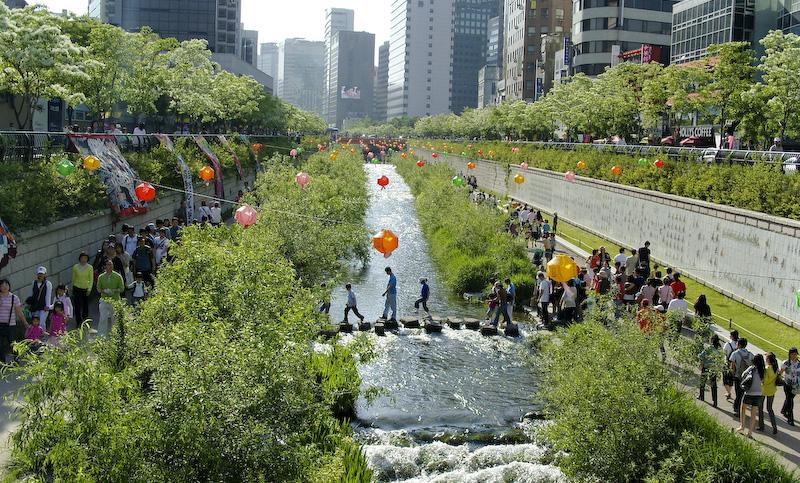
The video is very inspiring and I encourage you to watch it. Could we similarly re-connect to some of our industrial waterways?
Anyway, in the video they interview some professorial type engineers who study traffic flow. And they figured that even though they removed a very busy highway, the traffic still moved quickly. In the end, it even sped up a bit.
And this is a concept that is hard for people to get there heads around. I've talked about it with people, and they think I am flat out wrong. But it is proven to be true that widening roads and adding lanes does not solve congestion, but often increases it. One person in the video says a good analogy is that people think traffic is like liquid in a tube, and that if one part is squeezed, then the other arteries clog or fatten. But the analogy is false. Traffic is better thought of as a gas in that it can compress and expand to fill whatever is built.
Below are a few links I found that try to partially explain this phenomenon:
The Road Paradox:
Did you know that adding a road to a road network can actually slow traffic? We've all had our suspicions that new roads don't always help, but it can actually be shown mathematically.
Induced Demand:
Motorways and bypasses generate traffic, that is, produce extra traffic, partly by inducing people to travel who would not otherwise have done so by making the new route more convenient than the old, partly by people who go out of their direct route to enjoy the greater convenience of the new road, and partly by people who use the towns bypassed because they are more convenient for shopping and visits when through traffic has been removed.
Externality:
When car owners use roads, they impose congestion costs on all other users.
Downs Thomson Paradox:
...states that the equilibrium speed of car traffic on the road network is determined by the average door-to-door speed of equivalent journeys by (rail-based or otherwise segregated) public transport.
It follows that increasing road capacity can actually make overall congestion on the road worse. This occurs when the shift from public transport causes a disinvestment in the mode such that the operator either reduces frequency of service or raises fares to cover costs. This shifts additional passengers into cars. Ultimately the system may be eliminated and congestion on the original (expanded) road is worse than before...
The Braess Paradox
The video is very inspiring and I encourage you to watch it. Could we similarly re-connect to some of our industrial waterways?
Anyway, in the video they interview some professorial type engineers who study traffic flow. And they figured that even though they removed a very busy highway, the traffic still moved quickly. In the end, it even sped up a bit.
And this is a concept that is hard for people to get there heads around. I've talked about it with people, and they think I am flat out wrong. But it is proven to be true that widening roads and adding lanes does not solve congestion, but often increases it. One person in the video says a good analogy is that people think traffic is like liquid in a tube, and that if one part is squeezed, then the other arteries clog or fatten. But the analogy is false. Traffic is better thought of as a gas in that it can compress and expand to fill whatever is built.
Below are a few links I found that try to partially explain this phenomenon:
The Road Paradox:
Did you know that adding a road to a road network can actually slow traffic? We've all had our suspicions that new roads don't always help, but it can actually be shown mathematically.
Induced Demand:
Motorways and bypasses generate traffic, that is, produce extra traffic, partly by inducing people to travel who would not otherwise have done so by making the new route more convenient than the old, partly by people who go out of their direct route to enjoy the greater convenience of the new road, and partly by people who use the towns bypassed because they are more convenient for shopping and visits when through traffic has been removed.
Externality:
When car owners use roads, they impose congestion costs on all other users.
Downs Thomson Paradox:
...states that the equilibrium speed of car traffic on the road network is determined by the average door-to-door speed of equivalent journeys by (rail-based or otherwise segregated) public transport.
It follows that increasing road capacity can actually make overall congestion on the road worse. This occurs when the shift from public transport causes a disinvestment in the mode such that the operator either reduces frequency of service or raises fares to cover costs. This shifts additional passengers into cars. Ultimately the system may be eliminated and congestion on the original (expanded) road is worse than before...
The Braess Paradox
20 May 2009
Rowing, Rowing, Rowing on the River

Congratulations to the Cincinnati Junior Rowing Team which took home the Midwest Junior Rowing Championship this past weekend. They won 8 gold medals as well as the Team Points Trophy with a total of 215 points. The second team earned 106.5 points. The Cincinnati team advances to the Nationals which will be held in June.
 Congratulations to Steven Boyle, Lance Brown, Sam Elsbrock, Eric Garbon, Tom Garry, Matthew Habel, Clay Kadon, Brad Kallmeyer, Adam Miller, Grant Olscamp, Arthur Olson, Ian Powers, Damien Retzinger, Michael Robison, Nick Shaffer, Jacob Smith, Alex Spaulding, Tom Spraul, Eric Swank, Clay Wagner, Dan Weber.
 Every day after school and most Saturdays you can find them on the Licking River. During the winter they train in the tank under Montgomery Inn Boathouse. They compete throughout the eastern USA and Canada.
16 September 2007
Concession Stands Rarely Open
In the city, instead of a private yard, we have city parks. Fortunately, Cincinnati has some wonderful parks, so instead of spending my weekends cutting grass, or other yard maintenance, we spend hours biking and playing in our local parks, and we appreciate them very much. However, after spending so much time in them, we also notice the faults.
One such fault is that the concession stands are rarely open. For example, a few weeks ago, I spent a Saturday at the lovely, 1,000 hands playground and sand volleyball court (that we use as a sandbox), at Sawyer Point Park:

[where: 815 E. Pete Rose Way, Cincinnati, OH 45202]
I didn't take lots of pictures of the people here, as I don't like to take lots of pictures of other people's kids, but it was quite crowded. Despite this, the private contractor vendor, next to the playground was closed, as usual:

We were looking for a cool drink and maybe lunch, so we took a longish, but very pleasant walk along a shaded path, with pavers marking geologic time, towards the other end of the park:

When we arrived, we found another closed concession stand:

Then, famished, we decided to walk across the Purple People Bridge to see if Kentucky offered any relief:

There, we found a simple information stand with cold drinks and snacks:

I go to one of the local parks usually a few times a week, but rarely see one open. I have seen the stand at Eden Park Twin Lakes open once, and it was swamped with kids getting snacks. I have seen the one on the Serpentine Wall open several times, especially during festivals. But they don't keep regular hours.
I get the impression that the stands are only open when they can be guaranteed of a profitable day. But they have a monopoly on sales in the park. If the private contractor cannot guarantee to be open minimum hours, then the park should be opened to competition from other vendors.
One such fault is that the concession stands are rarely open. For example, a few weeks ago, I spent a Saturday at the lovely, 1,000 hands playground and sand volleyball court (that we use as a sandbox), at Sawyer Point Park:

[where: 815 E. Pete Rose Way, Cincinnati, OH 45202]
I didn't take lots of pictures of the people here, as I don't like to take lots of pictures of other people's kids, but it was quite crowded. Despite this, the private contractor vendor, next to the playground was closed, as usual:

We were looking for a cool drink and maybe lunch, so we took a longish, but very pleasant walk along a shaded path, with pavers marking geologic time, towards the other end of the park:

When we arrived, we found another closed concession stand:

Then, famished, we decided to walk across the Purple People Bridge to see if Kentucky offered any relief:

There, we found a simple information stand with cold drinks and snacks:

I go to one of the local parks usually a few times a week, but rarely see one open. I have seen the stand at Eden Park Twin Lakes open once, and it was swamped with kids getting snacks. I have seen the one on the Serpentine Wall open several times, especially during festivals. But they don't keep regular hours.
I get the impression that the stands are only open when they can be guaranteed of a profitable day. But they have a monopoly on sales in the park. If the private contractor cannot guarantee to be open minimum hours, then the park should be opened to competition from other vendors.
01 September 2007
Staking out a good view

36hrs before the fireworks show, these nuts are staking out their prime spots. Seems like a waste of time to me. It is only a fireworks show.
I remember going to one of the first fireworks shows when I was 12 or 14 (1978?) and there were some long-haired kids diving off those ice-breakers. Seemed kinda dangerous, and I haven't seen anyone jump off one since.
Subscribe to:
Posts (Atom)


 Posts
Posts


